Senin, 11 November 2019

| | 0 komentar

Reading Test

this learning focus for grade VIII E-G 11-15 November 2019 to take the score in reading.

the students only read the text that the teacher gave to them.

focus on scoring
1. pronounciation
2. fluently
3. reading
Read more...

Senin, 04 November 2019

Preposition of time

| | 0 komentar

Listening section

this material will be taught for grade VIII E-G start for 04 - 08 november 2019.
The aim for this material for :
1. The students can know about the preposition of time
2. based on the video, the students can using preposition of time in sentences

look at the video, try to understand


Read more...

Jumat, 01 November 2019

Expressing Polite Request1.

| | 0 komentar

Expressing Polite Request (LANJUTAN AKHIR)

This material will be teach for grade IX A-H 28-01 nov 2019.

look at the aim for learning :
1. the student can listen the audio
2. the students can write the conversation based on their listening

Listen this audio carefully, then write down all of the conversation:


here are many ways for you to make requests in English politely. Most of the polite requests are in the form of questions.

Would you / Would you like to / Could you …?

The most common polite way is to use Would you/Would you like to/Could you to ask other people to do somethings. We use it to suggest or request something more polite than Do you want to …?
Polite requestsAnswer YesAnswer No
Would you please give me the file on the table?Yes, of course.Well, I am afraid …
Could you join us at a party on this Sunday?Yes, I am happy to joinI am sorry I am busy this Sunday.
Would you like to join us at a party on Sunday?Yes, certainlyI’d like to but … + reason.


Would you mind / Do you mind …?

Would you mind + Verb-ing
Do you mind if I + Verb
If you think the answer maybe negative, and you want to sound more polite, you can use Would you mind …?
  • Would you mind helping with my exercise?
    Yes, certainly.
  • When you leave the room, would you mind closing the door?
    No, not at all!
We use Would you mind if I or Do you mind if I to make a request, we may be anticipating possible objections:
  • Would you mind if I take your car to work today?
    No, not at all.
  • Do you mind if I go out to buy some apples now?
    No, of course not.
Remember that ‘Do you mind…?’ and ‘Would you mind…?’ mean ‘Is it a problem for you?’ so the polite answer when we ‘say yes’ is ‘No’.

Asking for permission

Can I / Could I / May I / Might I
We use Can I / Could I / May I / Might I to request something for your self, all of these forms are possible. May and Might are consider to be more polite than Can and Could. We see the following examples:
  • Can I have a biscuit?
    Yes, of course
  • Could I ask you a favour?
    Of course you can.
  • Could I possibly have another sandwich?
    I don’t think so. You’ve had too much.
  • Might I leave the class a bit earlier today?
    Yes, you can.
  • If you’ve finished with the computer, may I borrow it?
    Yes, please do.
Might is more frequenly used in indirect questions, as an indirect softens the request. Note the further polite alternatives that we can use.
  • I wonder if I might leave the class a bit earlier?
Others way to say it are:
  • Would it be OK if I left the class a bit earlier?
  • Would I be able to leave the class a bit earlier?

Remember

 It’s more polite to use these phrases.

  • Would you mind if I…?
  • Could I possibly…?
  • Could you possibly…?
  • Do you think you could…?

Look at this video


Read more...

Kamis, 31 Oktober 2019

SIMPLE PRESENT TENSE

| | 0 komentar

SIMPLE PRESENT TENSE for grade VIII
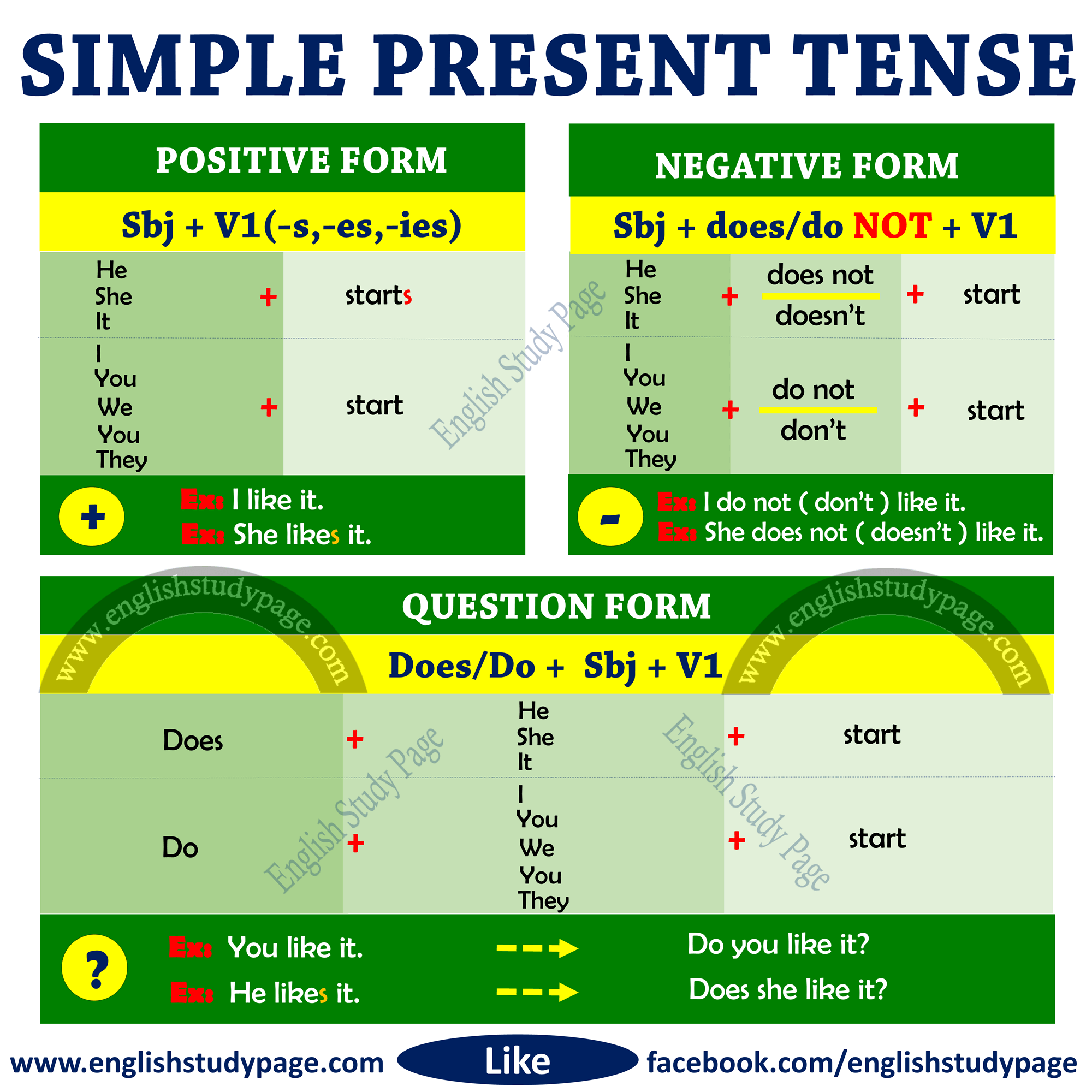
This post includes detailed expressions about simple present tense and its structures in english. Please follow the list about Structure of Simple Present Tense;
The tenses simply show the time of an action.
Simple Present Tense indicates an action which happens in the present, but it isn’t necessary for actions to happen right now. Simple present tense indicates, unchanging situations, general truths, scientific facts, habits, fixed arrangements and frequently occuring events.
The Structures of Simple Present Tense
POSITIVE FORMS (+) :
  • Subject ( I, You, We, They ) + V1  ( First Form of Verb )
  • Subject ( He, She, It ) + VERB – S / ES / IES
NEGATIVE FORMS (-) :  
  • Subject ( I, You, We, They ) + do not / don’t + V1  ( First Form of Verb )
  • Subject ( He, She, It ) + does not / doesn’t + V1  ( First Form of Verb )
QUESTION FORMS (?) :
  • Do + Subject ( I, You, We, They ) + V1  ( First Form of Verb )
  • Does + Subject ( He, She, It ) + V1  ( First Form of Verb )
SHORT ANSWER FORMS ( + / – ) : 
  • YES / NO + Subject ( I, You, We, They )+ do / do not (don’t)
  • YES / NO + Subject  ( He, She, It ) + does / does not (doesn’t)

POSITIVE (+)NEGATIVE (-)QUESTION (?)
I startI do not (don’t) startDo I start
You startYou do not (don’t) startDo you start
He startsHe does not (doesn’t) startDoes he start
She startsShe does not (doesn’t) startDoes she start
It startsIt does not (doesn’t) startDoes it start
We startWe do not (don’t) startDo we start
You startYou do not (don’t) startDo you start
They startThey do not (don’t) startDo they start
ATTENTION:
1. In Simple Present Tense, we add the suffix -s at the end of the verbs for the third singular subjects ( He, She, It ) . On the other hand, we use first forms of the verbs for other subjects ( I, You, We, You, They).
2. Although we add the suffix -s at the end of the verb for the their
Examples:
  • My mother does not (doesn’t) let  me go out with my friends.
  • do not (don’t) prefer my coffee black.
  • She does not (doesn’t) put the keys on the table.
  • The teacher does not (doesn’t) shout at us all the time.
  • do not (don’t) have two brothers.
  • Coffee does not (doesn’t) grow in Brazil.
Question Sentences ( Do/Does + Sbj + V1)
Examples:
  • Does your mother let you go out with your friends?
  • Do you prefer your coffee black?
  • Does she put the keys on the table?
  • Does the teacher shout at us all the time?
  • Do have two brothers?
  • Does coffee grow in Brazil?
NOTES:
We use other question words ( Like Who, What, Why , How much / many, How often etc.) in present tense.
1)
Question Words (who, what, why, how much / many, how often etc.) + do / does + subject pronoun ( he, she, it, I, you, we, they) + V ( First Form of Verb )
Examples:
  • How often does he call you?
  • Why do you always do this?
  • How much does it cost?
look at the video

Read more...

Kamis, 24 Oktober 2019

Modals Auxiliary

| | 0 komentar

MODAL AUXILIARY

The material will be taught for grade VIII E-G for 21 - 25 Oktober 2019 and the aim for this material are:
1. the students can know about modal auxiliary such as : CAN, MUST, SHOULD, WILL
2. The students can using each modals based on the usage

look at this video to lead you  understanding about modals


Read more...

Rabu, 16 Oktober 2019

Expressing asking and giving Ordering in Restaurant

| | 0 komentar

Expressing asking and giving ordering in Restaurant

 this material will be taught for grade VIII E-G for 30 september 2019. Look at this video :

and look this situation :


The aim for this material :
the students can know how to expressing asking and giving in Restaurant.
the students can try to practice with thier friend
Read more...

Jumat, 27 September 2019

FUTURE TENSE

| | 0 komentar

FUTURE TENSE

This material will be taught for grade IX A-H start 23 -27 september 2019. this material has at our modul and only focus on listening.
The goal for this learning :
1. The students can understand about using "will" and "going to" in future sentense based on video
2. The students can using "will" and "going to" in their sentences

look at the video to clear the material :
Do the exercise above
Listen carefully !

1. I____ ______ ______ ______ to the store.
2. Where ______ you _______ _______ _______?
3. How______ he _______ ______ _______ to work?
4. We_____ ________ ______ _______ a movie.
5. _____ it ________ ________ ________ tonight?
6. These shoes ________ _______ _____ _______big enough. (negative)
7. What time ______ she ________ ______ _______?
8. He_____ ________ ______ _______ the dishes.
9. How much ____ that _______ _______ ________?
10. They _______ _______ _______ _______ this. (negative)


Read more...

Rabu, 18 September 2019

LISTENING EXERCISE FOR GRADE VIII

| | 0 komentar

LISTENING EXERCISES

This exercises for takes scoring in listening, the material is about preposition for grade VIII E-G, and will be taught start 16- 21 September 2019.
the aim for this material is the students can review and check their vocabulary about preposition.
  1.  the students can know about preposition of place
  2. The students can mention the answer based on the video
look at this video

Read more...

Popular Posts

Blogger templates

Blogroll

About

Blog Archive

Cari Blog Ini

Diberdayakan oleh Blogger.

Materi Ajar Rabu 29 Juli 2026


Designed by: Compartidísimo
Images by: DeliciousScraps©